


For the customer, an enquiry that nobody has answered is no different from an enquiry that got lost.
Imagine a Tuesday afternoon in November. A farmer finishes configuring a machine on the manufacturer’s website and sends an enquiry for a quote. The enquiry goes to the dealer in their region, and an email with the full configuration lands in the dealer’s inbox.
Wednesday is a public holiday. On Thursday the salesperson is out visiting farms from early morning, and the email waits among dozens of others. On Friday the farmer calls another dealer.
At the manufacturer’s head office the enquiry looks fine: it has come in and has a dealer assigned. What the data does not show is that nobody has opened it for three days.
Assigned does not mean handled
Assigning an enquiry to a dealer is easy to measure. It is harder to see what happened next: whether the dealer received the message, whether anyone opened the enquiry, who took it over and when the customer heard the first reply.
The scale of the problem can be surprising. In a study published in January 2026, the American company Pied Piper sent enquiries through the websites of 772 compact tractor dealers. Within a day, 47% of the enquiries had received no personal reply.
A missing reply is rarely a matter of bad will. More often, nobody has the longest-waiting enquiries in front of them. Each party sees this problem a little differently:
- Customer: wants to know that someone has read the enquiry and to hear back before asking elsewhere.
- Salesperson: wants to know which enquiry needs a response today and which one can wait until tomorrow.
- Dealership owner: wants to see whether the team responds on time, without going through employees’ inboxes.
- Manufacturer: wants to know whether enquiries from its website and campaigns get an answer, not just who they were passed to.
Assigning an enquiry is the start of handling it, not proof that it has been handled.
One clock that knows working days
That is why, in the CRM of JAPRIVIO CPQ, every machine enquiry from the configurator and every parts enquiry gets two deadlines the moment it arrives. The first is for the dealer’s team to accept the enquiry, the second for the first response to the customer. The CRM can be enabled for a manufacturer and its dealer network.
The clock counts working days only. Saturdays, Sundays and Polish public holidays do not count, including Christmas Eve, which has been a non-working day since 2025.
An enquiry sent on Friday at 15:00 has a first-response deadline of Monday at 15:00. An enquiry sent at the same time on Tuesday 10 November has its deadline on Thursday, because 11 November is a public holiday.
By default, the dealer’s team has 4 working hours to accept an enquiry and 1 working day to give a first response. The thresholds are set separately for each manufacturer. The manufacturer’s administrator sees them in the company settings, changes are made by the platform operator, and every change is recorded in the history.
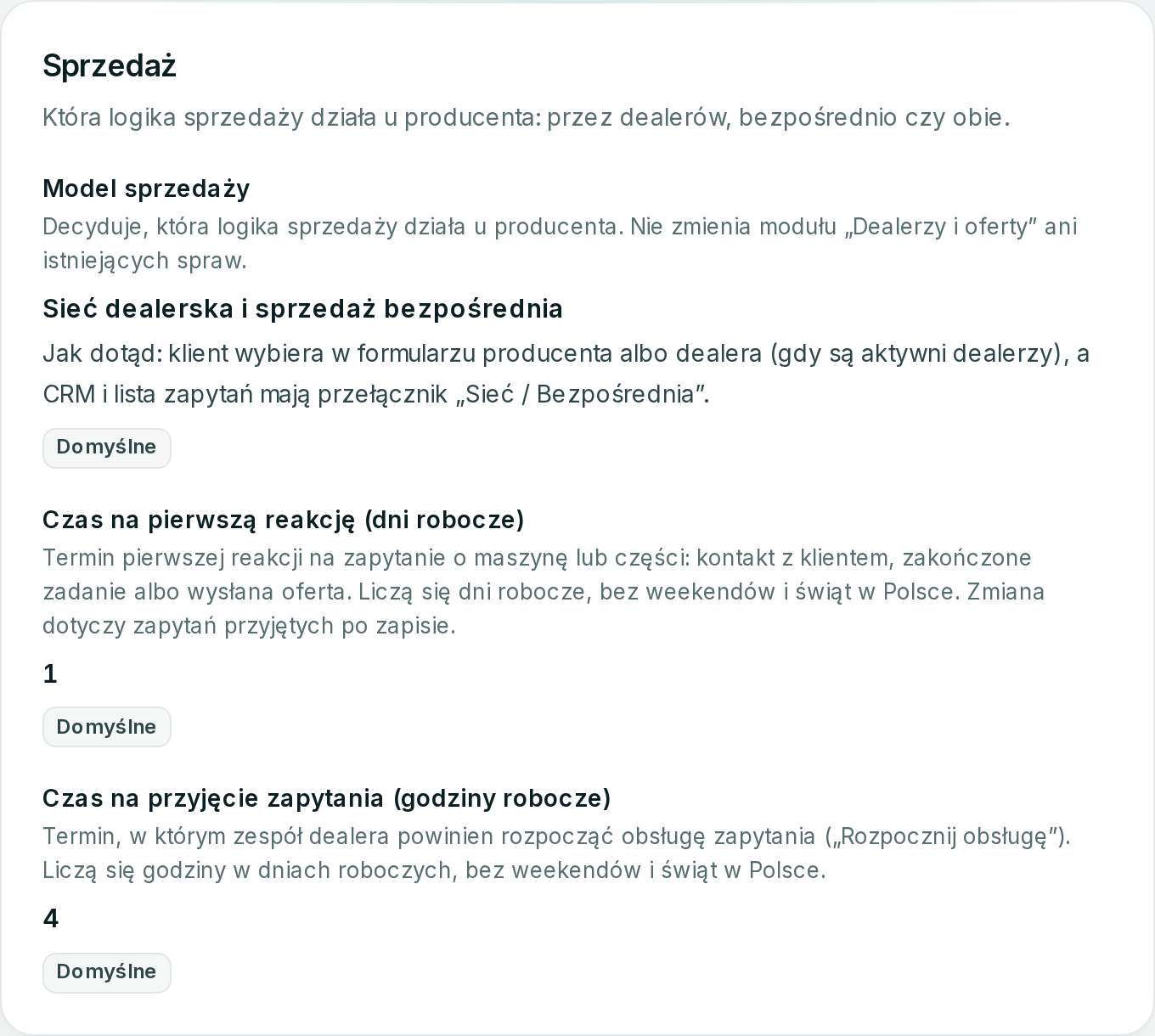
A change to the first-response threshold applies to enquiries that arrive after it is saved. Open enquiries keep their deadline, so nobody moves the goalposts in the middle of a case.
Five steps instead of one status
Instead of a single “assigned” status, the system distinguishes the successive steps of handling. Each one answers a different question:
- Assignment: the enquiry has a dealer or an owner responsible for it.
- Email to the dealer: the mail server has accepted the message with the enquiry.
- Opening: someone from the dealer’s team has opened the enquiry card for the first time.
- Acceptance: the team has chosen “Start handling”, and the enquiry has become a sales opportunity with an owner.
- First response: contact with the customer, a completed task or a sent quote.
An email accepted by the mail server does not mean that anyone has read it. That is why we count the opening separately, and only when the dealer’s team opens the card. An administrator or the manufacturer opening the enquiry card does not change this date.
The first response is the earliest of three events: a contact with the customer marked in the system, a task completed on the enquiry (a call, an email or a meeting), or a quote sent from the sales opportunity created from that enquiry.
Only separate steps show where an enquiry is really waiting.
The enquiry card shows how much time is left
On the enquiry card the salesperson sees two clocks: one for accepting the enquiry and one for the first response. Each shows the deadline and the state: waiting, deadline approaching or deadline passed. The warning appears 4 working hours before the deadline.
After the response, the clock stays on the card as a record: on time or late, with the date. Next to it, the card shows when the dealer’s team first opened the enquiry.
Accepting an enquiry does not stop the response clock. An enquiry that someone accepted, but where nobody contacted the customer, moves to the list of overdue enquiries once the deadline passes, next to those that nobody accepted.
The customer does not see that the enquiry was accepted. They see that someone got in touch.
Figures for the network, not a ranking of dealers
On the dealer’s dashboard, the enquiry handling time block counts these steps for the selected period: how many enquiries had a deadline, how many were assigned, how many emails the mail server accepted, how many enquiries were opened and accepted, and how many got a first response. Next to them are the average time to accept in working hours and a link to overdue enquiries.
The manufacturer sees the same figures for the whole network, plus the average time to first response and the number of overdue enquiries. It sees them in aggregate, without a breakdown by dealer.
Principle: the clock is there to help reply to the customer on time, not to rank dealers. The figures show where enquiries are waiting, and people discuss the reasons.
This is a deliberate decision. Poorly chosen measures could judge a dealer unfairly, for example for an enquiry whose email never reached them.
What the clock does not do today
The clock does not know a company’s working hours: a working day counts in full, and the calendar only knows Polish public holidays. Deadlines apply to machine enquiries from the configurator and to parts enquiries. The contact form, the dealer’s own website, manually added enquiries and requests for help in the configurator do not have them yet, and neither do enquiries from before this change.
The system also does not send reminders or escalate on its own. In-app reminders and a suggested escalation to the dealer’s manager and the manufacturer’s representative are a direction for the next stage of development, once we have checked how the clock works on real enquiries. The system does not move the customer to another dealer: a person decides on the assignment.
What changes for the salesperson, the dealer, the manufacturer and the customer
The salesperson sees on each enquiry card how much time is left and does not have to keep deadlines in mind. The dealership owner sees whether the team accepts enquiries and gets back to customers on time, before anyone calls to complain.
The manufacturer knows whether enquiries from its website and campaigns get an answer across the network and can talk to dealers about facts rather than impressions. The customer has a better chance of hearing back from the dealer they wrote to before asking elsewhere.