


A good configurator does more than stop customers from choosing what is not allowed. It also tells them why.
An evening after a day in the field. A farmer sits down at the computer to configure a tractor they would like to buy before the season. They pick the model and the transmission, then move on to the tyres. One of the tyre sets is greyed out and cannot be selected.
If the configurator does not say why, two options remain. The customer guesses or calls the dealer the next morning. In the season, a salesperson takes many such calls and each time repeats the same knowledge: what fits with what, when a variant makes sense and what cannot be combined.
This year, such conversations matter more than usual. According to an Erste Leasing press release from March 2026, the record year 2025 for machinery financing, driven by subsidies from Poland’s rural development programme (PROW), is followed by a calmer period, and uncertainty may make farmers more cautious about investing. That makes what customers can find out on their own, before they call the dealer, all the more important.
That is why a configurator cannot be just a list of options. It should answer the questions a customer would ask a salesperson.
Customers do not need more options. They need to understand the ones in front of them.
Where the questions that keep coming back to sales come from
Most configuration questions are not caused by missing data. The manufacturer knows how the transmission variants differ and which tyres fit which model. But this knowledge lives in PDF catalogues, training materials and the heads of experienced staff, not where the customer makes the decision.
Each side sees the same problem a little differently:
- Customer: wants to understand what they are paying for and why something cannot be selected, without waiting for a call back.
- Dealer salesperson: wants to talk about the farm’s needs instead of explaining once again which tyres fit which model.
- Manufacturer: wants the whole dealer network to talk about the product in the same way and to stop receiving configurations that cannot be built.
Option descriptions where the decision is made
In the JAPRIVIO configurator, an option can carry a short description in an “i” window. It is not a paragraph copied from a catalogue. The description has a fixed structure: what the variant is, when to choose it, what it gives and what its limitations are, and where needed also conditions and the options it works with.
Take the KOLIBRI 8 demonstration tractor. The description of the 60 km/h continuously variable transmission says that it suits frequent road travel with a trailer, shortens transit times and requires specific tyres. These are exactly the sentences a salesperson would say on the phone.
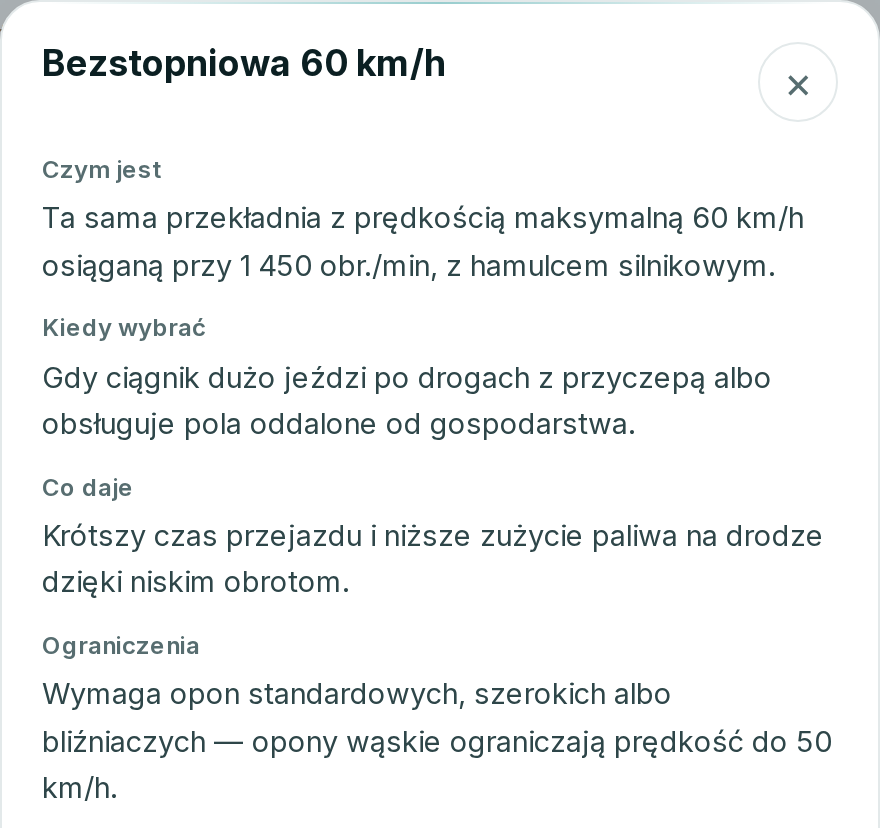
Such a description works twice. The customer makes an informed decision without waiting for a conversation. A new salesperson in the dealer network has the same knowledge at hand as an experienced colleague, in words prepared by the manufacturer.
An unavailable variant says what it is missing
The second source of questions is options that cannot be selected. A rule-based configurator has to block them, otherwise machines that cannot be built reach the dealer. But blocking alone is not enough. A grey tile without an explanation looks like a website error.
That is why an unavailable variant in JAPRIVIO shows the reason. Next to the low-pressure VF tyres, the customer sees that they require choosing the Kolibri 8.34 model first. For narrow tyres, the configurator reminds them that they only fit the 50 km/h transmission. The customer knows what to change if a given option matters to them.
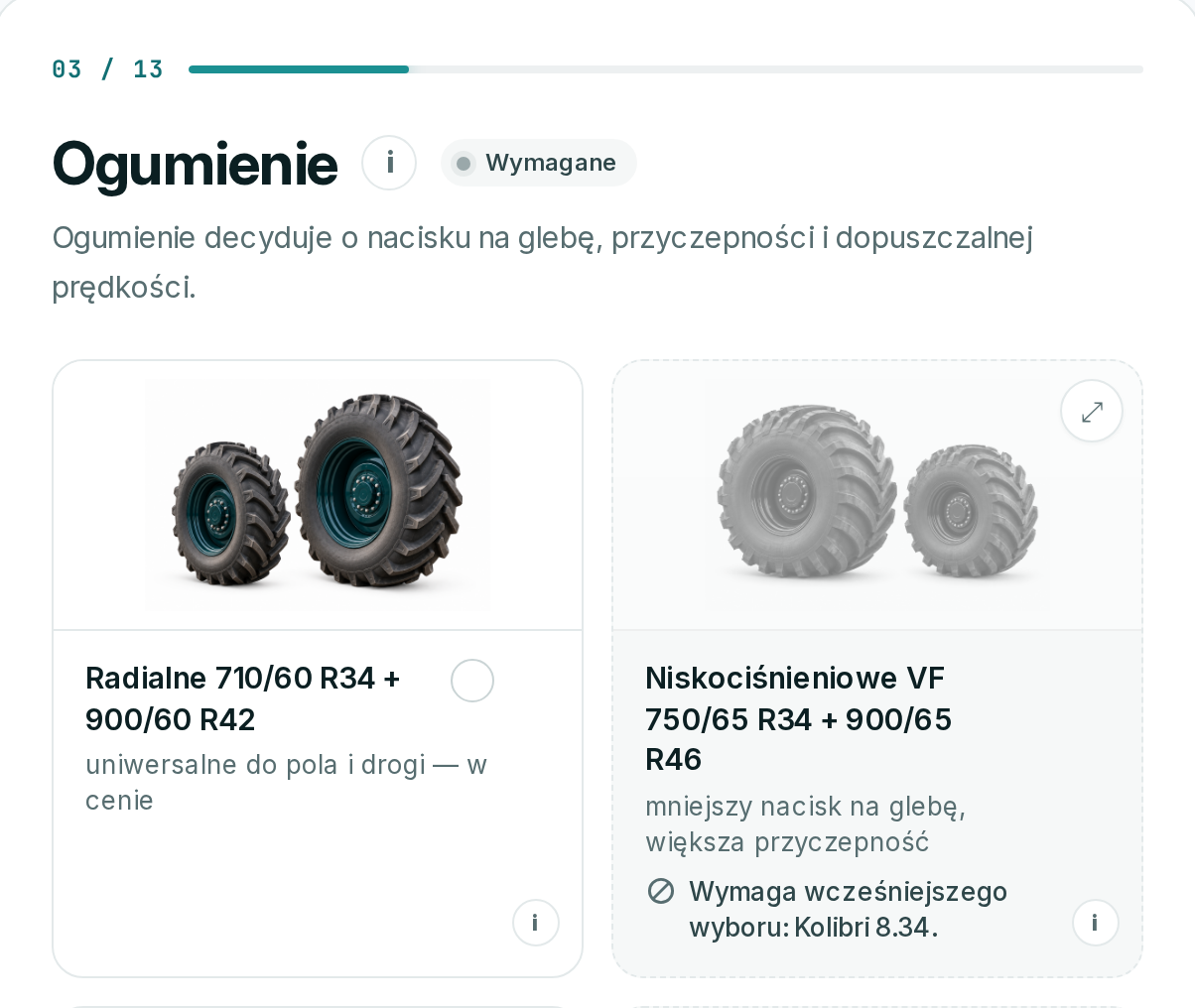
Variants that do not apply to the selected model at all can simply disappear from the list instead of turning grey. The server also checks the rules when the configuration is saved, so an incompatible combination goes no further, even if someone tries to bypass the page.
Principle: every block in the configurator has a reason the customer can read.
Configuration code: one machine, one name
The third element is a summary that updates with every choice. Next to parameters such as engine power, weight, top speed or wheelbase, the configurator shows the configuration code, for example JA-K831-EV9Z.
The code has a readable beginning that identifies the brand and model, followed by four characters calculated from all choices. Changing any option changes the code. The last four characters contain no letters I, L, O or U, which are easily confused with digits, so the code can safely be dictated over the phone or copied from a document.
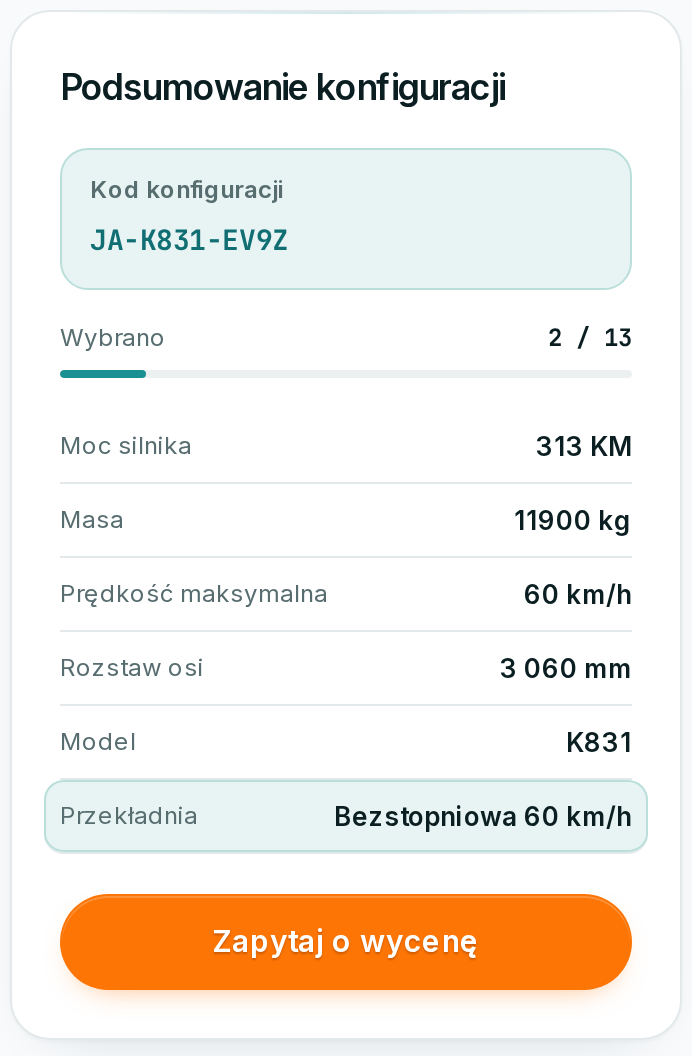
This way the customer, the dealer and the manufacturer talk about the same machine. Instead of a list of options copied into an email, one code is enough, and it appears in the inquiry and then in the quote.
The manufacturer’s knowledge in one place
Descriptions and rules only help when they are up to date. In JAPRIVIO, the manufacturer can maintain them independently in the configuration editor. There, option names, descriptions and photos are edited in three languages, along with the order of steps, the availability of options for each model and the compatibility rules.
Every change goes to a draft first and reaches the configurator only after publication. Previously saved configurations, inquiries and quotes stay unchanged, and an earlier version of the catalogue can be restored as a draft. Entirely new machines are prepared by the platform team at the manufacturer’s request.
- Manufacturer: describes the option and the rule in the editor, in a draft.
- Publication: the change reaches the configurator for new configurations.
- Customer: reads the description and the reason for unavailability at the moment of choice.
- Inquiry: the dealer or the manufacturer receives a complete configuration with the code, the purchase timeframe and information about financing.
What changes for the customer, the dealer and the manufacturer
- End customer: understands their choice and comes to the dealer with a ready configuration rather than a list of questions.
- Dealer: receives inquiries for machines that can be built and can focus the conversation on the farm’s needs, timing and financing.
- Manufacturer: maintains one consistent body of product knowledge for the whole network and has fewer configurations to correct.
A configurator does not replace the salesperson. It takes over repetitive explanations so that the conversation with the customer can start with what really matters. For us, this is what technology in sales is about: it should strengthen the specialist, not pretend they are unnecessary.
The first conversation about a machine starts in front of a screen
In a calmer year, every conversation with a customer carries more weight. A customer who goes through a configuration alone in the evening holds the first conversation about the machine before anyone from the dealer gets in touch.
The quality of that conversation decides whether the next day the salesperson receives an inquiry for a specific machine or a call asking why something is grey. A configurator that explains choices keeps working when the dealer’s showroom is closed.
Every answer the customer does not have to look for removes one obstacle between configuration and inquiry.