


At an international trade fair it is easy to collect contacts. It is harder to decide who will reply to each visitor in their own language and in their own country.
EIMA International in Bologna takes place in 2026 from 10 to 14 November. According to the organiser, FederUnacoma, the Italian federation of agricultural machinery manufacturers, the previous edition in 2024 was visited by 346,800 people, including 63,100 visitors from abroad, from 150 countries.
Picture the stand of a Polish machinery manufacturer. In a single day a farmer from Romania, a dealer from France, a service company from Germany and a visitor from a non-EU country all stop by. Each asks for a quote, and each leaves a business card or a number saved in the salesperson’s phone.
Back at the office, those contacts have to be retyped, translated and distributed. Some wait a week because nobody knows who should take them. The farmer from Romania knows nothing about that. All they know is that nobody got in touch.
A business card is not yet an enquiry
At the stand, the conversation matters, not a form. The trouble starts later: a business card does not say which machine and in what configuration the visitor looked at, in which language they want to talk, or who sells the manufacturer’s machines in their country.
After a domestic fair this is easy to make up, because the dealer network is divided into regions and the salespeople know each other. At international fairs there are also countries where the manufacturer has an importer, countries with one dealer for the whole market, and countries with nobody yet.
- Manufacturer: wants to know how many enquiries the fair brought and whether each one has someone to reply to it.
- Dealer or importer abroad: wants to receive a customer’s enquiry from their market straight away and with the configuration, not a week later in a forwarded email.
- Salesperson at the stand: wants to talk to the visitor, not retype their details and translate lists of options.
- Customer: wants to see the machine in their own language and to know who will contact them.
A trade fair enquiry is only worth something when it is clear who will reply to it.
One link per stand, in the visitor’s language
In JAPRIVIO CPQ the manufacturer has its own website with a configurator. The link to the configurator can point straight to a language, for example Italian or German. It works like clicking a flag on a website: the visitor sees the site, the configuration steps and the enquiry form in the chosen language.
Without a specified language, the site chooses one itself: based on the visitor’s earlier choice, the country recognised from the IP address, or the browser language. The base languages are Polish, English and German. French, Spanish, Dutch, Ukrainian and Italian are enabled for manufacturers who need them.
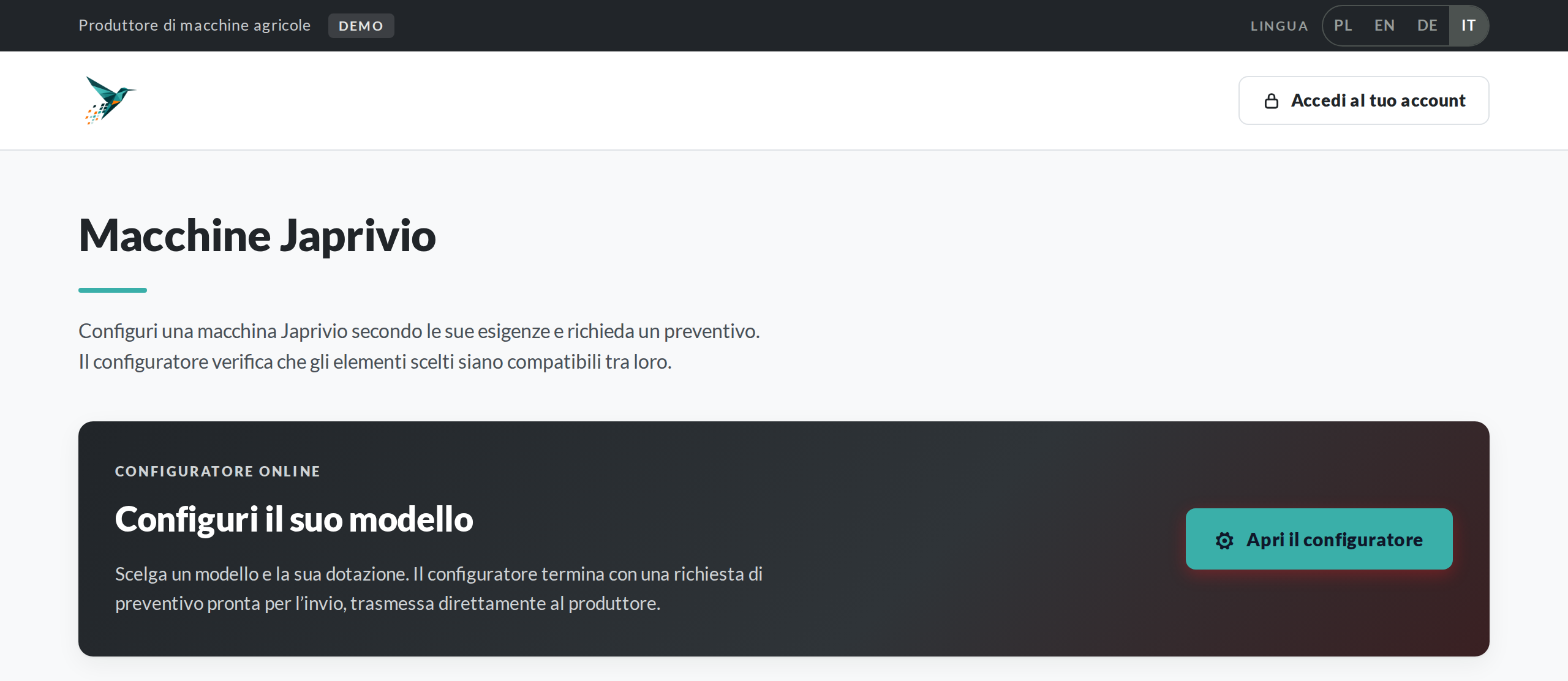
This is the website of the JAPRIVIO demo brand opened with a link in Italian. The switch at the top lets the visitor change the language with one click.
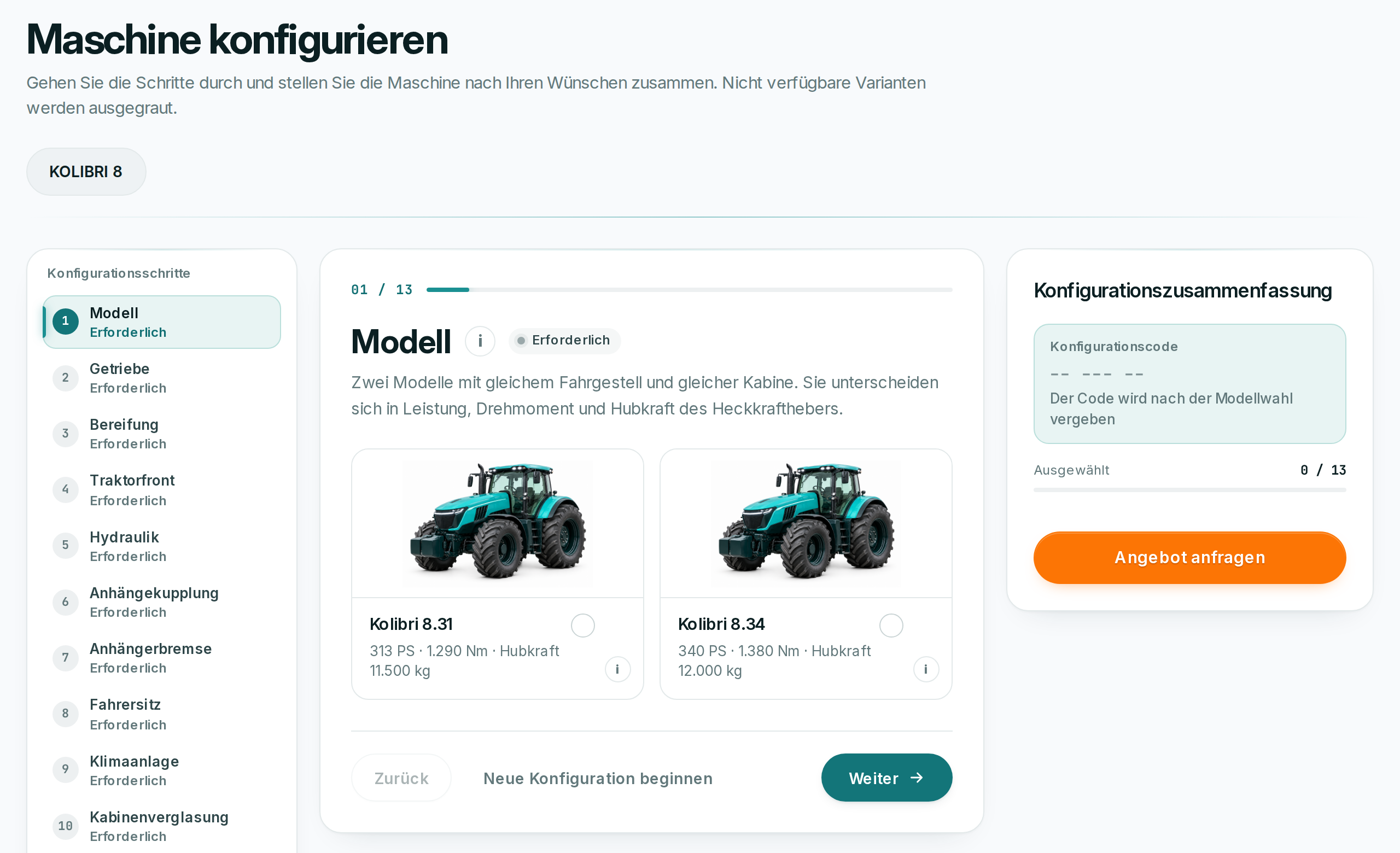
The configurator works the same way in every enabled language. The steps, options and compatibility rules are shared, and the equipment codes do not change. Below is the first step of the KOLIBRI 8 machine configurator in German, on the demo environment.
There is one condition: the manufacturer’s catalogue must have descriptions in the given language. Texts that have not yet been translated are shown in English. Before the fair, it is therefore worth going through the configurator in the languages of the visitors you expect.
A visitor from another country should see the machine in their own language before they see the form.
The campaign in the link shows what the fair brought
You can add a source and a campaign name to the link, for example “eima-2026”. The visitor does not see it, and the system remembers the tag with the configuration they have started. When the customer sends an enquiry, the source and campaign are saved on the lead in the CRM.
The simplest approach is to prepare a separate link for each version of the materials at the stand, for example a leaflet in Italian and a poster in English, and turn it into a QR code. After the fair, the team sees on every enquiry which campaign it came from, without counting business cards.
The tag has one limitation. If the customer closes the page and returns to the configurator a few days later by another route, for example from a search engine, the new enquiry will no longer be tagged with the trade fair campaign.
A form that knows the customer’s country
After the configuration, the customer fills in the enquiry form. The “Country” field starts with the visitor’s country, if the manufacturer’s site has the language of that country. The phone dialling code is set according to the country, and the postcode field also accepts foreign codes, not only the Polish format.
The voivodeship appears only for an address in Poland. A visitor from Spain does not have to choose a Polish region to send an enquiry, and a German postcode will not be read as a Polish voivodeship.
The list of dealers in the form narrows down to the customer’s country. A visitor from France sees the manufacturer’s partners from France, not the whole Polish network. If there is no dealer in a given country, the form shows all of them, so that the customer is not left with an empty list.
Who receives the enquiry
The enquiry goes to a specific dealer or to the manufacturer’s queue according to one predictable rule:
- Customer’s choice: the customer picks a dealer from their country or, if the manufacturer also sells directly, handling by the manufacturer.
- Dealer: the chosen dealer receives the enquiry and an email with the full form, that is, the configuration, contact details and the customer’s answers.
- Address in Poland: the voivodeship from the postcode or from the form shows whether the chosen dealer serves that region. The customer’s choice still takes precedence, and any mismatch is visible on the lead.
- Manufacturer: an enquiry addressed directly to the manufacturer, or one for which a single dealer cannot be determined, goes to the manufacturer’s queue with the reason described.
- Customer: sees a confirmation that the enquiry was sent and, if they gave an email address, receives a message with a summary of the configuration.
The reason for the assignment is saved on the lead in plain language, for example that the customer chose the dealer themselves or did not give the details that would allow one to be identified. After the fair it is therefore easy to check why a given enquiry went where it went.
The rule: the system does not guess on behalf of the customer or the manufacturer. When it is not possible to say clearly who will handle the enquiry, it waits with the manufacturer with the reason described, and a person decides on the assignment.
What we do not do today
Automatic matching of a dealer to a region works only in Poland, because it relies on voivodeships. Abroad, the dealer is decided by the customer’s choice from the list for their country. When several partners operate in one country, the customer chooses between them, and the system does not split enquiries by that country’s regions.
The short trade fair form, launched with a separate link, is prepared for the Polish market. It asks only for a name, a phone number or email, and a postcode or voivodeship, has two separate consents and saves the source “Targi”. It assumes an address in Poland, though, so at an international fair the regular configurator link with a language and a campaign works better.
The configurator also does not translate the catalogue by itself. Descriptions of machines and options in each language have to be prepared in the manufacturer’s catalogue, just like the Polish version.
Five steps before you leave for the fair
Before an international fair, it is worth going through five steps:
- Country map: for each market from which we expect visitors, we establish who replies to enquiries: an importer, a dealer or the manufacturer’s head office.
- Partners in the system: each foreign dealer has a country on their card, so that the customer sees them on the list in the form.
- Languages: we go through the configurator in the visitors’ languages and fill in any missing option descriptions.
- Links: we prepare links with a language and a campaign name for each version of the stand materials and turn them into QR codes.
- Duty: we appoint a person who reviews the manufacturer’s queue every day during the fair and right after it.
The last step is the most important. An enquiry assigned to a partner is only the beginning of the handling, so it is worth agreeing straight away how much time the team has for a first response.
The customer’s choice takes precedence, and every assignment has its reason saved.
What changes for the manufacturer, the dealer and the customer
The manufacturer does not retype business cards or send emails to partners. Every enquiry comes with a country, a configuration, a source and a campaign, and those that do not yet have an owner wait in one queue.
The dealer or importer receives the customer’s enquiry from their market straight away, with the configuration in codes they know from the catalogue. The salesperson at the stand focuses on the conversation, because the customer enters the details themselves, in their own language. The customer gets a reply from someone who sells machines in their country.